Learn things.
Really.
Whatever you’re studying becomes a deck of cards. When a card is due, you answer from memory, out loud or typed. AI grades it on the spot: what landed, what you missed.
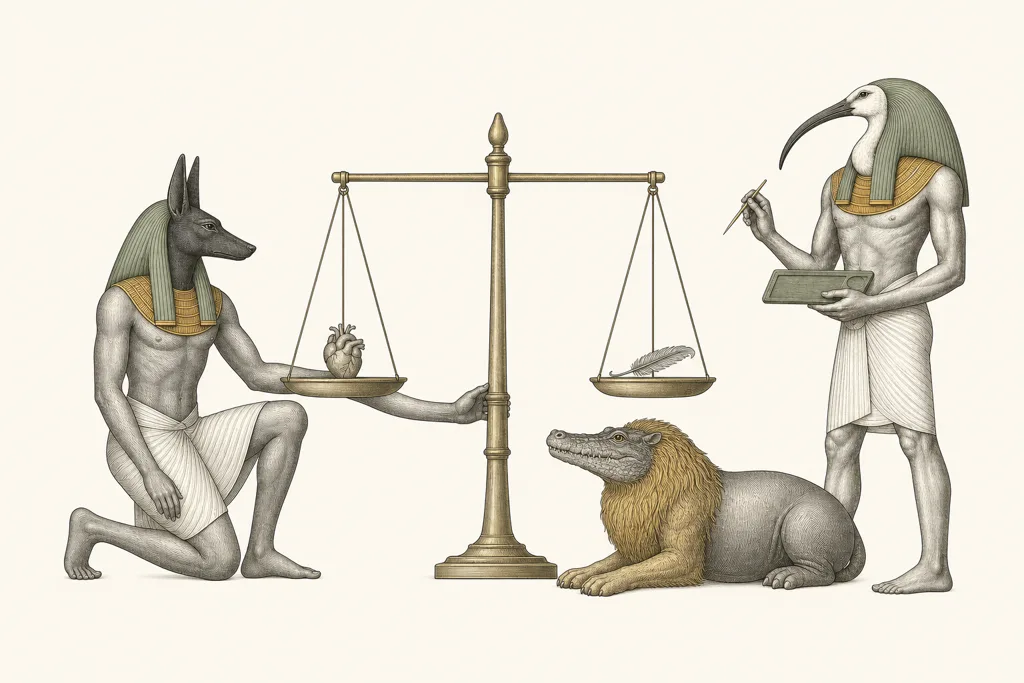
The scribe-god wears the head of this marsh bird. Why did it become the sign of writing?

the ibis — it’s Thoth’s bird, the god of writing
You got the bird and the god — but the card asked why the ibis became the sign.
Thoth’s bird — the god of writing
the curved beak: the crescent of the moon Thoth ruled, and a scribe’s reed pen
his other brief — counting, and recording the verdict at the weighing of the heart
Scroll to play
his other brief — counting, and recording the verdict at the weighing of the heart
After death, the heart was weighed against the feather of Maat — truth. A balanced scale meant paradise; a heavy heart was devoured. Thoth stood at the scale and recorded the verdict.
The heart of the dead was weighed against what?
The feather of Maat — truth. Balance meant paradise; a heavy heart was devoured, and Thoth recorded the verdict.
Ask follow-ups. Turn them into cards.
Dig into any card until you actually understand it. Each answer can become a new card: preview it, add it, keep going.
Scroll to play
Not in the mood for open answers? Self-review.
Every session starts with a choice. Self-review is the classic pass: reveal the answer and rate yourself. Free, no AI involved.
How are you studying?
The heart of the dead was weighed against what?
The heart of the dead was weighed against what?
AnswerThe feather of Maat — truth. Balance meant paradise; a heavy heart was devoured, and Thoth recorded the verdict.
You never write cards by hand.
Say the word in your AI chat and it files a deck for you — free, through the open-source MCP. Or give the built-in Deck Builder a topic: it plans, asks a few clarifying questions, and writes the whole deck, grounding fact-sensitive parts in real sources.
…so Thoth ties it together: the ibis-headed scribe of the gods — writing, counting, and the verdict at the weighing of the heart.
Make a deck from what we just covered.
create_deck·add_cards✓Works with any chat or agent that speaks MCP. Free and open source.
What do you want to learn?
The gods and the signs they wear8 cards
Hieroglyphs, scribes and the reed pen9 cards
Death, Maat and the weighing of the heart7 cards
How deep should hieroglyphs go?
Just how they work — I’m not learning to read them.
The gods and the signs they wear✓ 8
Hieroglyphs, scribes and the reed pen✓ 9
Death, Maat and the weighing of the heartwriting…✓ 7
One account. Every screen.
The same library in the browser and in the Android app. Add a deck on one screen and it’s on the other before you pick it up. Finish a review on the phone, and the laptop already knows. Sync is free.
Start with a deck that’s already built.
17 curated decks, hand-built and free with an account. Open one to see exactly what’s inside. A public marketplace of community decks is on the way.

Free comes with AI. Pro renews it every month.
The classic loop — self-review, imports, your own agent’s cards, sync — is free forever. The AI parts start free — 200 credits and 120 built cards with every account — and Pro renews them monthly.
No payment details. Includes 200 AI credits and 120 built cards.
- Cards from your own AI agent (open MCP)
- All 17 curated decks, plus the deck marketplace when it opens
- Self-review sessions with real FSRS scheduling
- Sync across web and mobile
Up to 250 decks / 10,000 cards.
Start free$64 billed yearly · saves $55.88/yr
- Everything in Free, plus a full month of:
- Typed & spoken answers, graded by AI
- Deep-dive follow-ups on any card
- AI Deck Builder — writes whole decks
Per month: 4,000 AI credits · 3,000 built cards.
Start freeQuestions, answered.
Instead of cramming, each card comes back right before you’d forget it — tomorrow, then in three days, then weeks. Every answer retunes that schedule: stumble and the card returns sooner; nail it and it moves out. LearnReally runs FSRS, the same modern scheduler Anki uses. One twist of ours: a card only counts as proven when you’ve produced the answer yourself — typed or spoken. Self-review keeps you moving, but on its own it never closes a deck.
No. Tap the mic and say it — a spoken answer is graded the same as a typed one. And if you’d rather not produce an answer at all, run a self-review session and rate yourself.
Any app that speaks MCP: Claude, ChatGPT, Cursor, Hermes, OpenClaw, and whatever ships next. The connector is free and open source. Mid-conversation, ask your assistant to turn what it just taught you into a deck — it lands in your library, synced everywhere.
It grades only against the reference and key points saved on the card — never against the model’s own knowledge. That’s the deliberate defense against a model confidently “correcting” you with something it invented. It judges meaning, not wording; the reference is always shown beside the grade; and the final rating is yours — the AI only suggests.
Free is the classic loop, forever: self-review sessions, all 17 starter decks, cards from your own AI agent through the open MCP, FSRS scheduling, and sync. Pro ($9.99/mo) adds the model-powered pieces: open answers graded by AI — typed or spoken — with deep-dive follow-ups, and the AI Deck Builder. Every new account starts free with 200 AI credits and 120 built cards — no credit card, no expiry.
In the browser and in the Android app — one account, synced free. iOS is planned.